
In Saskatchewan, we have a long winter and a short summer. During that short summer, our bees produce an amazing amount of honey. There are however long periods when the bees can not forage for themselves. It is necessary for us to provide additional nutrition during these periods. We can also improve the health of the hive by insuring the bees have the resources they need to build up a strong population for the summer harvest and the winter dearth.
Carbohydrates
Bees get their energy from sugars. Their preferred source is natural nectar, collected from flowers. In our cold climate, nectar is only available to the bees for three months or so. Since we are taking their nectar, which the bees have turned into honey, it is necessary to supplement the hive. There are basically two choices for feed sugar, sucrose and fructose.
Sucrose is our preferred choice at Struan Road Apiaries. Sucrose has been shown to produce an increase in brood rearing and is closer to nectar than the alternative, fructose. Oddly enough when a bee consumes sucrose, it is turned into fructose by the bees enzymes. Honey is mostly fructose, but there is something in that conversion that seems to stimulate them to produce more brood. Sucrose is also easier to obtain but it needs to be mixed with water. Granulated beet sugar can be found in any grocery store and can be purchased in 20kg bags for an economic source of sucrose.
Fructose is usually purchased as a liquid from a bee supply vendor and usually comes in a two to one ratio and is usually produced from corn. Corn syrup is usually bought by taking your feeder pails and getting them filled.
We also use fondant, which we purchase in 1kg packages. Fondant can be purchased made either from sucrose or fructose.
There are three times in the year that we feed our production hives, Early spring, late spring and fall.
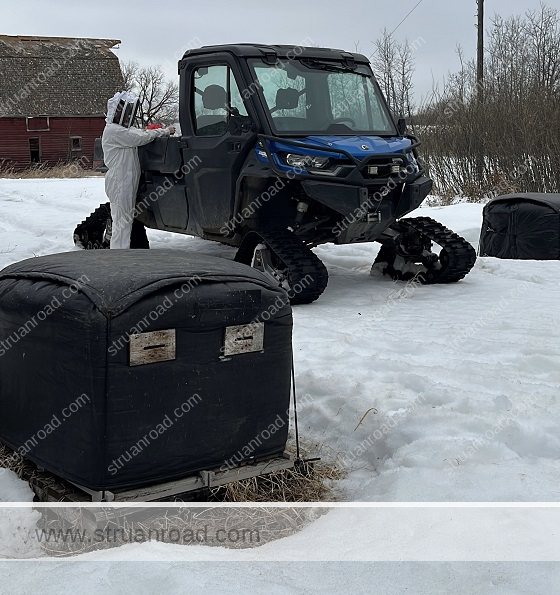
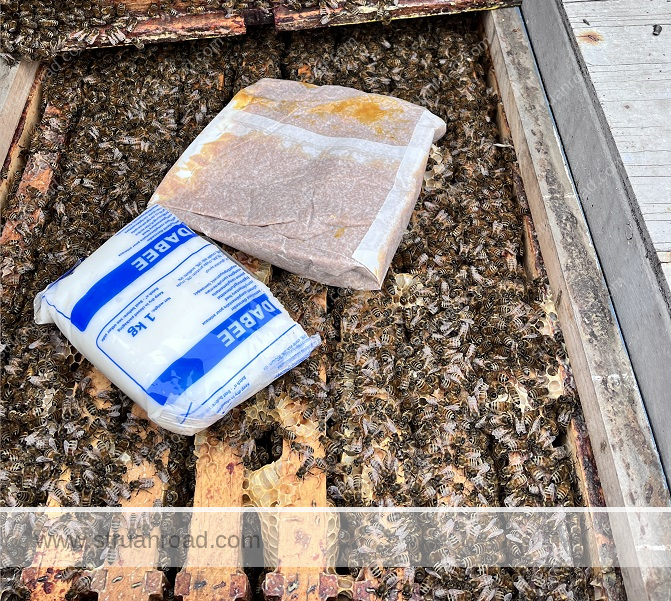
In the early spring, as soon as we can get into our yards, on a sunny day when the temperature is 5° C or better, we open the hives and put in a spacer and a 1/2 block of fondant. At this time of year, it is possible that the hives supply of honey is getting low, or that the supplies they do have are either inaccessible or crystalized and difficult to reconstitute. Canola honey is one of the worst for this. It is too early to use liquid sugar as it makes it hard for the bees to heat the hive. Liquid sugar is a big heat sink and can also wet the bees, making it impossible for them to keep warm. On subsequent visits to the hive, if the bees have consumed their fondant, we will give them another 1/2.
Later in the spring when the daytime temperatures are consistently 15 – 20° C, we feed a feeder pail worth of one to one water to sugar by weight. The form below can be used to calculate quantities. This ensures enough supply for the hive and also stimulates them to produce brood, especially if fed sucrose.
The last sugar feed is in the fall. The purpose of this feeding is to supply the hive with enough feed to overwinter. It is best to feed two to one sugar to water syrup as there is less water for the bees to evaporate and the excess water can also cool the hive. Some beekeepers start feeding as soon as the last honey is taken off the hive, usually near the end of August. We feel it is better to leave the feeding for a couple of weeks so the bees consume some of the canola honey and can “feel” winter coming. There are changes to the hive structure as well as to the bees themselves which sets them up for winter. Generally two pails is enough but it is best to feed as much as the hive will take.
Protein
Proteins are the building blocks of life. They are large molecules made up of amino acids. Bees get their protein in nature by collecting pollen from flowers. They store the pollen in cells by adding nectar, honey and digestive enzymes and packing it into cells. They actually use their heads to pack the cells. The pollen undergoes a fermentation process and becomes bee bread. This is the way the hive stores proteins for the lean months.
Proteins are essential for brood rearing and pollen inflow is one of the factors that regulates brood production. During inclement weather if there are a few days when there is no pollen gathering, bees may slow or stop brood production.
As a beekeeper there are two ways that we can supplement the protein intake of the hive, pollen patties and pollen feeders. Pollen patties can be purchased pre made, or made at home with our pollen substitute. To feed, a pollen patty is placed on the top bars in the top super. Pollen substitute is fed free range in a pollen feeder. There are large feeders made for the commercial beekeeper, but they are expensive and too large for the smaller beekeeper. We produce a feeder that is a good size for 1 to 20 hives.
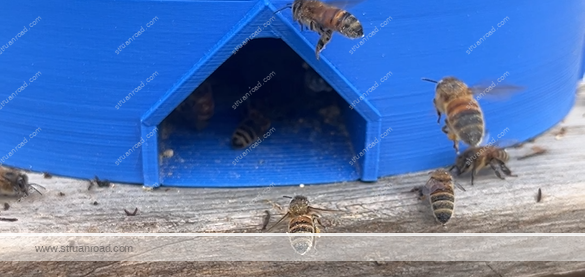
Pollen substitute should be available to the bees year round. If there is natural pollen available and the weather allows, bees will not use the pollen feeder as they prefer pollen from flowers. At other times, bees will feed at the pollen feeder whether it is a cool early morning or a warm day during the winter. Pollen substitutes vary in quality so it is important to get the best.
Pollen substitute should:
- Have the composition of natural pollen, balanced natural protein
- Be highly digestible, bees cannot digest soy
- Have balanced essential amino acids
- Be plant based, no hive products, synthetic materials or animal products
- No preservatives.
The pollen substitute that we have been using for years is the best we think there is. It is available in our shop.
Early in the spring, we feed pollen patties that we make ourselves. It stimulates brood rearing as well as invigorates the hive. Do not feed it too early though as it can cause digestive issues if the bees can not relieve themselves. Make sure that the weather is warm enough to allow cleansing flights.
The pollen feeders available are designed for commercial beekeepers. They are big and expensive. We have developed a feeder that is small enough for the back yard beekeeper. It will easily service up to twenty hives. There are built in screw holes designed to hold the feeder down to a board or pallet to prevent spillage. Pollen substitute should be available all year round. Bees will forage on it when they can not get to natural pollen, even on nice winter days. Pollen feeders should be placed in a protected spot at least two feet off the ground and at least twenty feet away from the hives. Bees do not lie to forage too close to a hive. Check it out in our shop.